

Custom Hill-Sachs Implant for Reconstruction of a Large Engaging Humeral Head Lesion
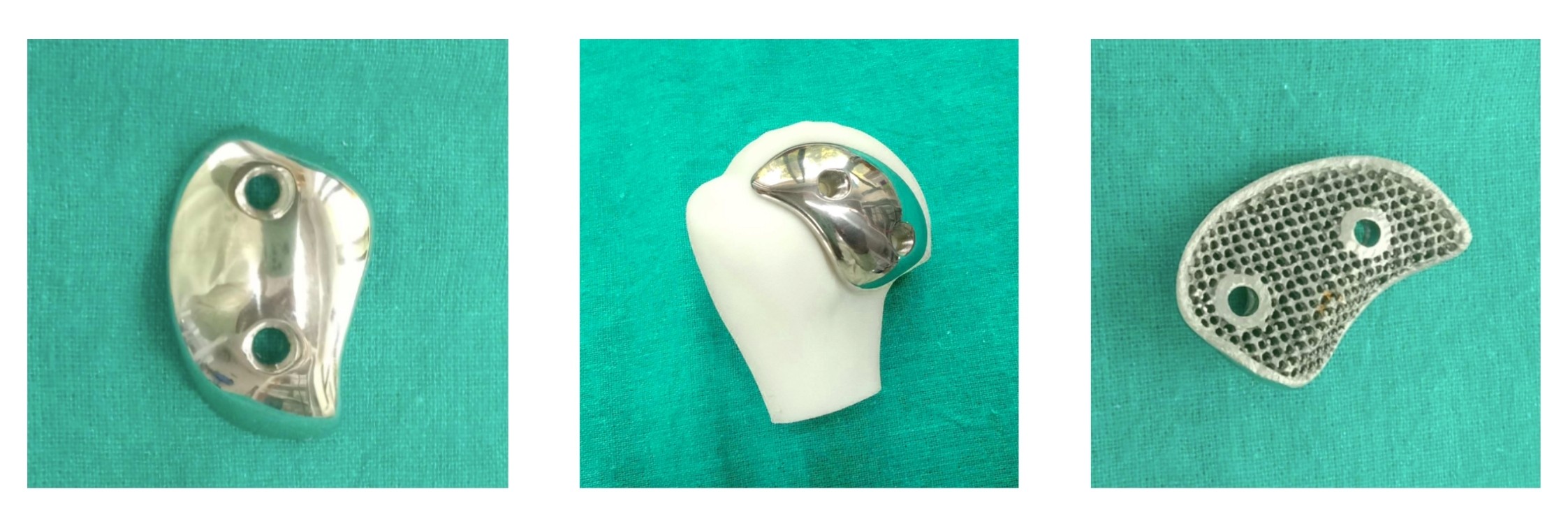
Patient Overview: Treatment of a Large Engaging Hill-Sachs Lesion
A 49-year-old female presented with recurrent anterior shoulder instability associated with a large Hill-Sachs lesion involving the left humeral head.
Preoperative imaging demonstrated an engaging humeral head defect that articulated with the anterior glenoid during shoulder motion, contributing to recurrent dislocation events. The defect measured approximately 22 mm × 41 mm, representing substantial bone loss and a significant compromise of the humeral articular surface.
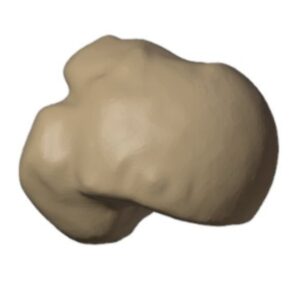
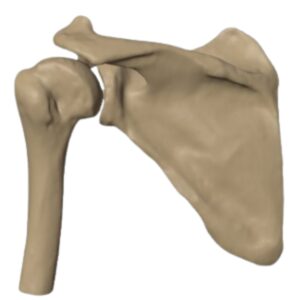
Surgical Challenge: Limitations of Standard Implant Solutions
The dimensions and morphology of the lesion made the use of standard dome implants unsuitable for reconstruction.
Achieving anatomical restoration required an implant capable of matching the patient-specific geometry of the defect while allowing stable fixation within the available bone stock.
As a result, a custom Hill-Sachs implant was developed to address the unique anatomical requirements of the case.
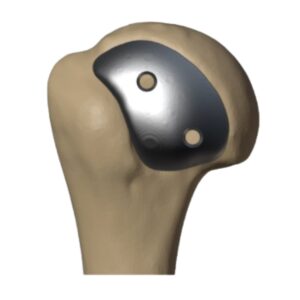
Patient-Specific Implant Design for Humeral Head Reconstruction
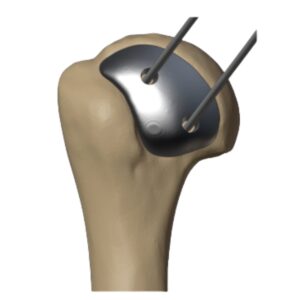
Using the patient’s imaging data, a custom implant was designed to accurately confirm the defect geometry and restore the native contour of the humeral head.
The reconstruction strategy was intended to:
- Restore the articular surface anatomy
- Eliminate engagement between the humeral defect and the glenoid
- Re-establish humeral head congruity
- Provide stable mechanical fixation
- Patient-Specific Hill-Sachs Implant
Guided Surgical Execution Using a Patient-Specific Drilling Guide
Following surgical exposure of the humeral head defect, a patient-specific drilling guide was positioned directly within the lesion.
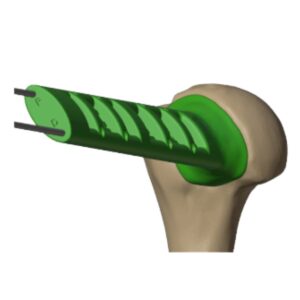
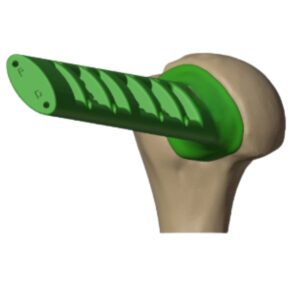
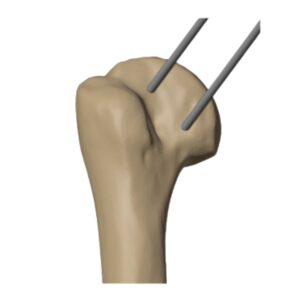
The guide facilitated the placement of two parallel K-wires, which provided the location and orientation for implant placement in the defect.
Clinical Significance: Patient-Specific Reconstruction for Large Hill-Sachs Defects
Large engaging Hill-Sachs lesions remain a challenging source of recurrent shoulder instability, particularly when the extent of bone loss exceeds the limitations of conventional reconstructive options.
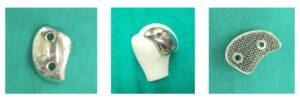
This case demonstrates the application of a patient-specific implant and instrumentation workflow for anatomical reconstruction of a substantial humeral head defect. The integration of preoperative planning, patient-specific guides, guided implant placement, and stable fixation enabled a structured approach to restoring humeral head anatomy and addressing instability in a case where standard implant solutions were not feasible.
Post-op Outcome
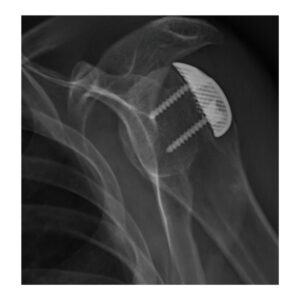
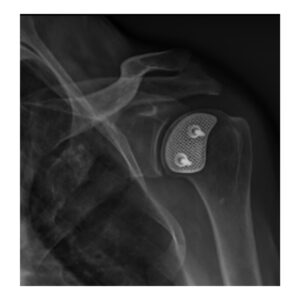
The reconstruction restored the humeral head contour and eliminated engagement with the glenoid, providing an anatomical solution designed to support joint stability and functional shoulder mechanics.